About POLARIS
Mission
POLARIS — the Platform for Omics, Longevity and Aging Biomarker Insights — is the front door to the Higgins-Chen Lab's aging-biomarker platform. It unifies a growing set of independent tools under one roof, so researchers can move seamlessly from discovering which biomarkers exist, to understanding the biology they capture, to seeing what the studies found, to judging which biomarkers actually perform.
Philosophy
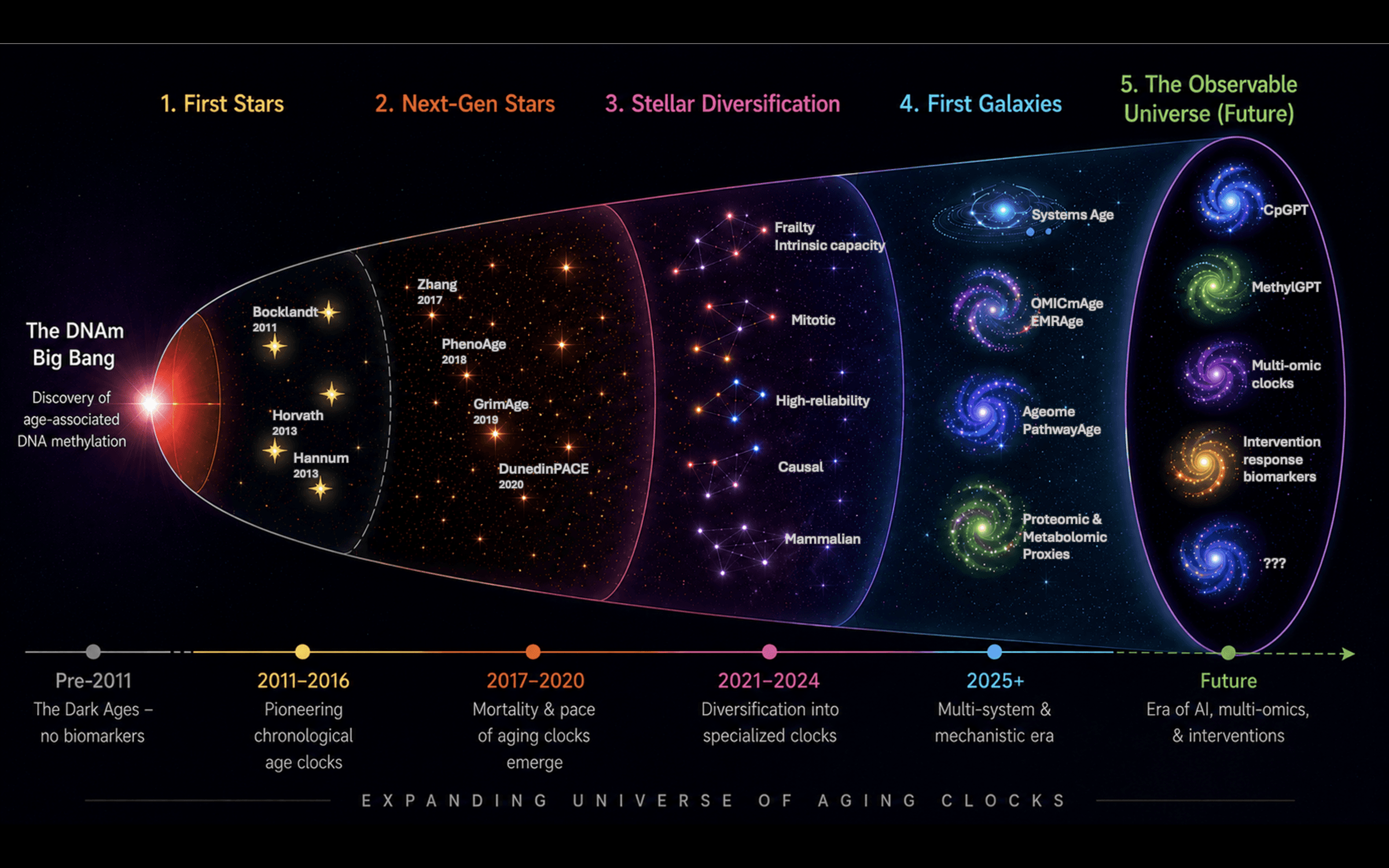
The universe of aging biomarkers is expanding faster than anyone can track it. POLARIS exists to help you navigate it — and to make its map open to everyone.
An expanding universe. New epigenetic clocks, datasets, and annotations appear almost monthly, scattered across papers, code repositories, and portals — more than any single researcher can follow. POLARIS is the North Star for that expanding universe: one place to see what biomarkers exist, understand what they measure, and judge how they perform.
Compared head to head. A crowded field is only half the problem; the other half is that no two studies test the same biomarkers. Most examine a single clock or a handful, and those that compare many calculate inconsistent sets of clocks — so findings accumulate in isolation, and when two studies disagree there is no way to tell whether the difference is biological or simply a different panel, population, or study design. That leaves real gaps: for most questions, the biomarkers you would most want to weigh against each other have never been measured side by side. POLARIS is built the other way around — a consistent panel of biomarkers calculated across harmonized datasets, so clocks and their combinations can be judged against one another on the same samples and the same outcomes, and you can see which one actually suits your question.
Democratizing the algorithms. For too long the algorithms behind aging biomarkers — their coefficients, metadata, and the knowledge around them — have been locked behind code you had to run, data you had to harmonize and analyze yourself, or expertise you had to already have. POLARIS brings them into the open, so the tools of aging research aren't reserved for a handful of labs.
Insight for anyone. You shouldn't need to be a bioinformatician to ask “which biomarker fits my question, and what does it actually capture?” POLARIS is built so its insights are legible to everyone — clinicians, students, researchers from adjacent fields, and the simply curious.
AI, used with care. The field now produces more data and literature than humans can possibly read. We use AI to help — summarizing, connecting, and surfacing what matters — but always anchored to verifiable ground truths: real algorithms, real coefficients, real studies. Here, AI is a lens for navigating complexity, never a replacement for the underlying evidence, and never a source of any claim you can't trace back to its origin. Our larger aim is a shared language for aging biology — one that connects otherwise disparate fields so that insight, collaboration, and conversation can flow across them.
Attribution
POLARIS is developed by the Higgins-Chen Lab. The platform's methods and findings are documented across our publications. This hub is an informational portal: it introduces each tool and routes you to it.
Funding
This work is funded by an AI at Yale Seed Grant and by grants from the National Institute on Aging.
License
License terms are coming soon. Please reach out if you have questions.